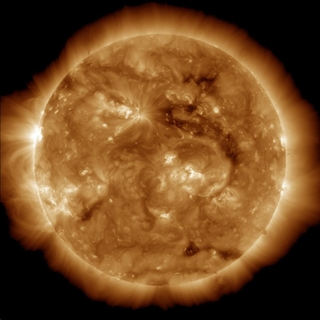
Solar wind leaving the sun. Credit: NASA Solar Dynamic Observatory
Neutrinos are extremely small, nearly massless, electrically neutral particles that belong to the family of fundamental particles in physics. They are among the most abundant particles in the universe, yet they are incredibly hard to detect because they interact only through the weak nuclear force and gravity, not through electromagnetism.
Neutrinos are affected by dark matter and dark energy in subtle but distinct ways: they experience the gravitational pull of dark matter, which can slightly bend or influence their paths as they travel through galaxies and clusters, though their weak interactions allow them to mostly pass through unaffected, while dark energy indirectly affects them by stretching the fabric of space, causing neutrinos traveling across cosmic distances to lose energy through redshift as the universe expands.
Researchers
-
Physics
Jackie Baeza-Rubio

-

-

-

-
Physics
Rohit Raut
